
Skill, Formula, and Expertise
Thinking, Fast and SlowThis flow compares intuitive professionals with statistical rules and asks when human expertise deserves trust.
increasing Bearing strength in each event
 decreasing
Bearing strength in each eventdecreasingObstacle Field Judgments
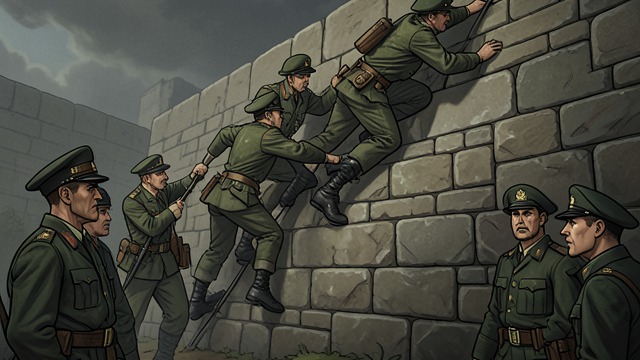
Leaderless Challenge
Character Reading
Observers interpret soldiers' behavior around a wall as evidence of future leadership.
Confidence
Their coherent impressions feel direct and predictive.
Feedback Failure

Predictions Collapse
Weak Validity
Later performance shows that the observers forecast little better than chance.
Persistent Belief
General knowledge of failure does not weaken confidence in individual cases.
Meehl's Challenge

Clinical Versus Statistical
Comparative Evidence
Simple formulas often outperform trained counselors using richer interviews.
Professional Resistance
The result threatens the dignity and identity of expert judgment.
Apgar's Score

Standardized Newborn Assessment
Five Variables
Virginia Apgar reduces complex clinical judgment to a small consistent scoring rule.
Practical Benefit
The formula helps identify endangered infants more reliably.
Structured Interviews

Disciplined Selection
Trait Scores
Israeli Defense Forces interviewers gather factual evidence and score traits separately.
Controlled Intuition
A final intuitive impression adds value only after disciplined data collection.
The author's early military service
Months after each military assessment
During the chapter on formulas
Later in the formulas chapter
Near the end of the formulas chapter
